


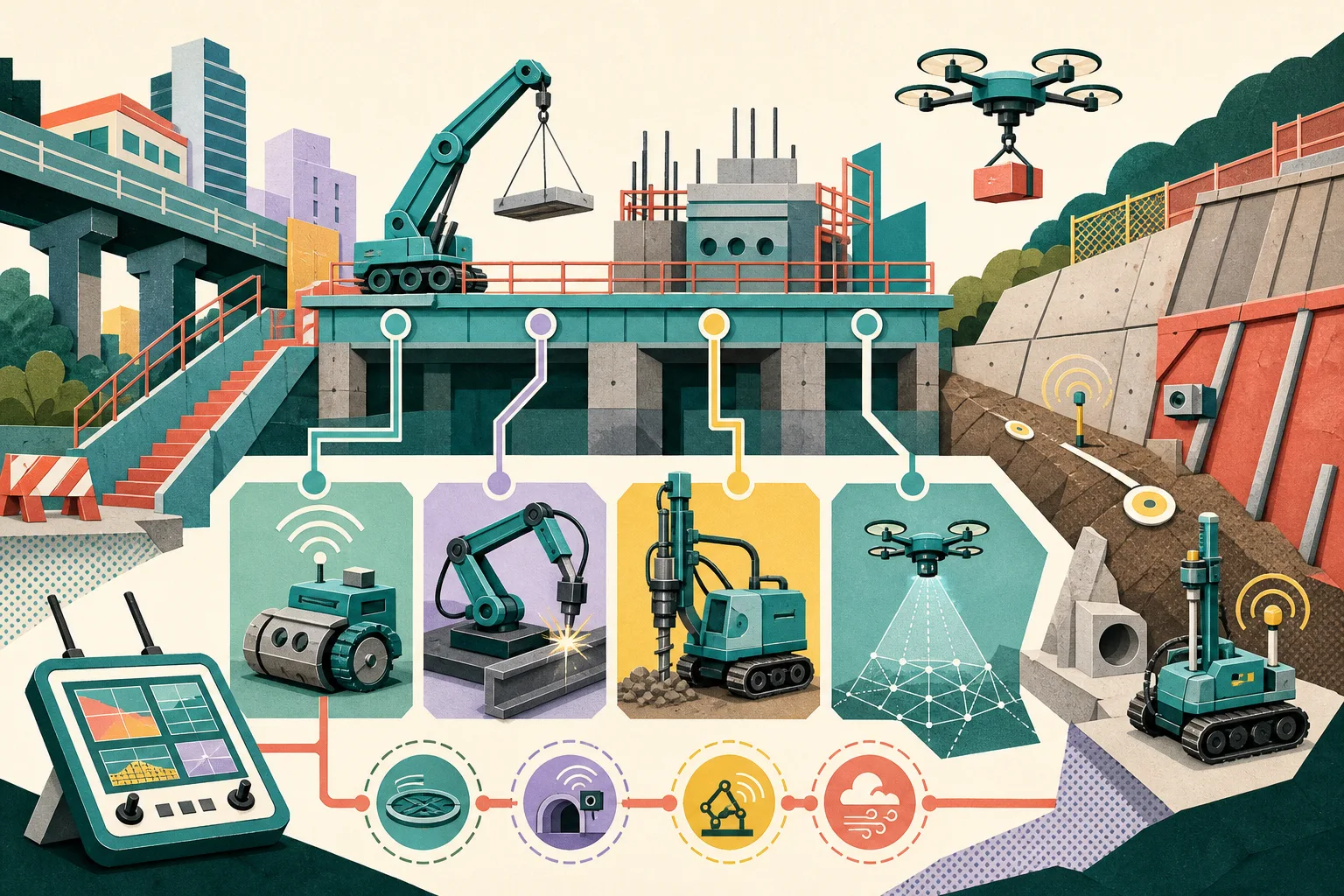
Hong Kong is expanding the use of robots in public works beyond construction procedures to include site inspections, facility maintenance and monitoring. More than 20 public works projects had adopted the first four categories of high-efficiency construction robots by August 2026, the Development Bureau said.
The bureau introduced a policy in December 2025 requiring public works projects to use high-efficiency construction robots where suitable. Development Secretary Bernadette Linn said the wider use of robots was intended to improve construction quality and site safety.
The first four categories are remote-controlled lifting systems, welding robots, drilling robots and drones for monitoring construction progress.
At the Civil Engineering and Development Department’s site works for public housing and infrastructure at A Kung Ngam Village in the Eastern District, a small drone is being used to carry tools and materials. Ming Pao reported that it can carry about 60kg at a time and may help shorten natural-slope works and reduce landslide risks during the wet season.
At a site on Tsing Yi West Road, a soil compactor has been fitted with remote-control and intelligent compaction-monitoring systems. Ming Pao reported that the arrangement is the first of its kind in Hong Kong, allowing operators and supervisors to work from a control room outside the fill area and reducing the risks of collisions with machinery and rollovers caused by unstable terrain.
The Buildings Department has introduced indoor automated painting and polishing robots at the Kwun Tong integrated development project. According to Ming Pao, their continuous automated process is four times as efficient as manual work; the brief does not provide an independent assessment of that claim.
Robots are also being developed for inspection and maintenance. The Drainage Services Department’s i-STAR cover-inspection robot uses artificial-intelligence visual recognition and multiple sensors to simulate the load of a worker on a cover and identify damage, deformation and installation abnormalities in real time. A spherical robot developed by the Electrical and Mechanical Services Department with the University of Hong Kong and Hong Kong Police is being used as a construction inspection assistant, transmitting live images and audio from confined spaces.
The Water Supplies Department and a robotics team have developed Smart Guard Dog, an inspection system combining a six-legged robot, intelligent navigation, artificial intelligence and multiple sensors. It can patrol preset routes and tasks automatically while monitoring equipment, abnormal temperature rises and environmental gas concentrations. The bureau is studying the addition of painting and materials-handling robots and plans to expand their use progressively.
The Development Bureau has commissioned the Hong Kong Construction Technology Research Institute to develop technical specifications for different types of robots. It also plans to continue issuing technical guidance and certification standards, although no timetable was provided for the additional robot categories or standards.