


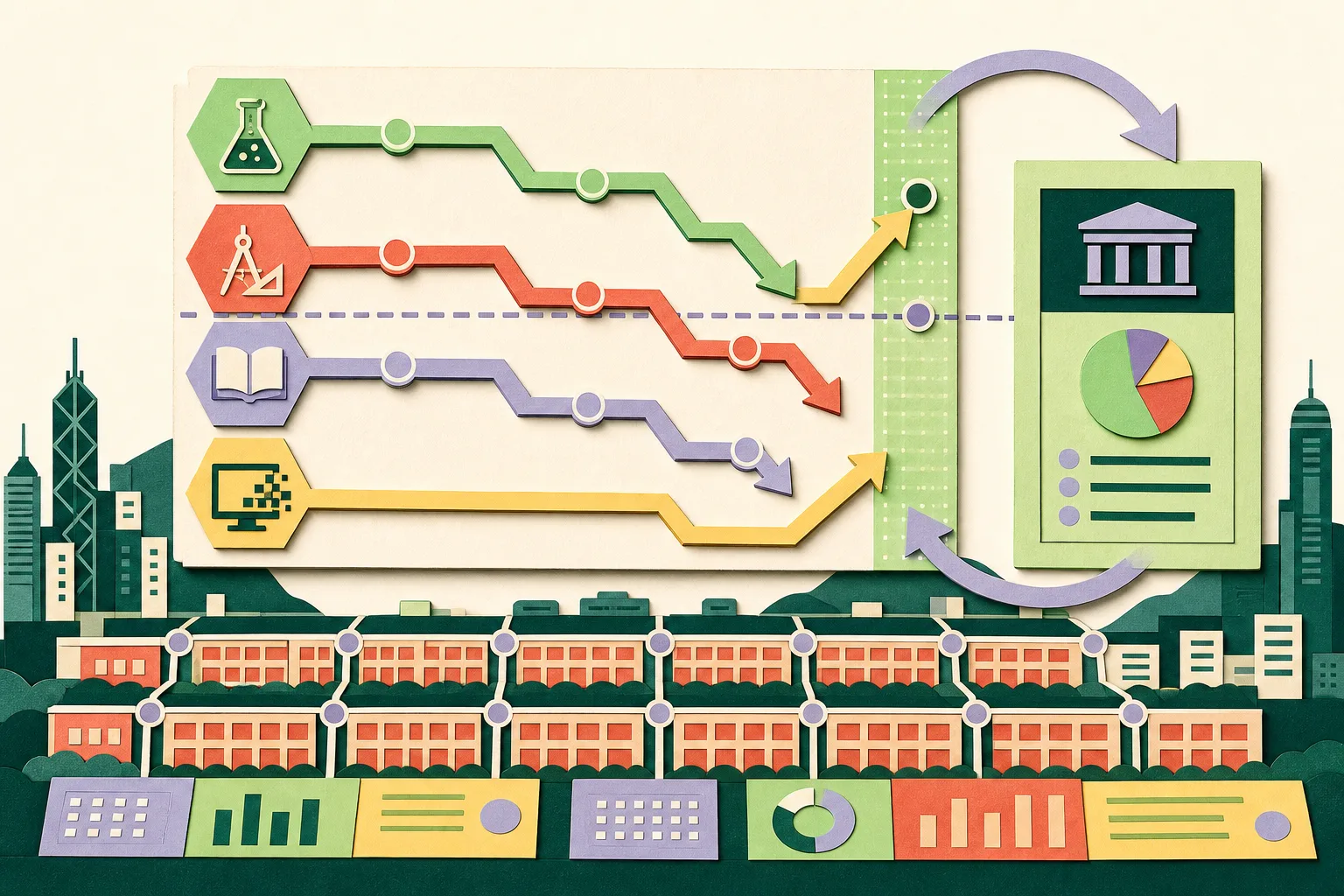
Hong Kong’s 15-year-olds recorded their lowest rankings since the city began taking part in the OECD’s PISA assessment in 2000, with declines in science, mathematics and mother-tongue reading compared with 2022. The results, released on 8 September 2026, prompted the Education Bureau to say it would review the findings and testing arrangements.
Hong Kong’s science ranking fell from seventh to 16th, mathematics from fourth to seventh, and mother-tongue reading from 11th to 15th. Its science score dropped 24 points, from 520 to 496; the reports did not give the precise score changes for mathematics or reading.
Despite the falls, Hong Kong students remained above international averages in all three core domains. They scored 522 against an international average of 463 in mathematical literacy, 496 against 482 in scientific literacy, and 480 against 461 in mother-tongue reading literacy.
Students performed more strongly in the innovative Learning in the Digital World domain, scoring 545 compared with an international average of 500. Hong Kong ranked sixth, with a higher proportion of top performers and a lower proportion of low performers than the international average.
Organised by the OECD, PISA measures how well 15-year-olds apply knowledge to real-world and unfamiliar situations. Hong Kong’s assessment was led by the University of Hong Kong, with 6,445 students from 230 secondary schools taking part between May and July 2025.
The Education Bureau said the results in the three core domains showed a marked discrepancy with observations in the education sector. It said possible factors included the way PISA was positioned as an academic research project, students’ psychological state and concentration during testing, test-administration arrangements, and their after-school digital-device habits and attitudes.
Researchers offered several possible explanations, but no single cause has been established. One linked the decline to learning disruption during the Covid-19 period, while another associated more fragmented reading and increased short-video consumption with weaker reading and reflection abilities.
Frederick Leung, the PISA 2025 project leader and national project manager, cautioned against treating PISA as the sole or definitive measure of student ability because of cultural differences between economies. He said the international decline was not confined to Hong Kong and that artificial intelligence was not a leading factor, although PISA would place greater emphasis on AI-related literacy in future.
The bureau said it would examine the results and assessment arrangements with the University of Hong Kong research team and education stakeholders. It also referred to an Education Performance Evaluation Expert Group established by the authorities.