


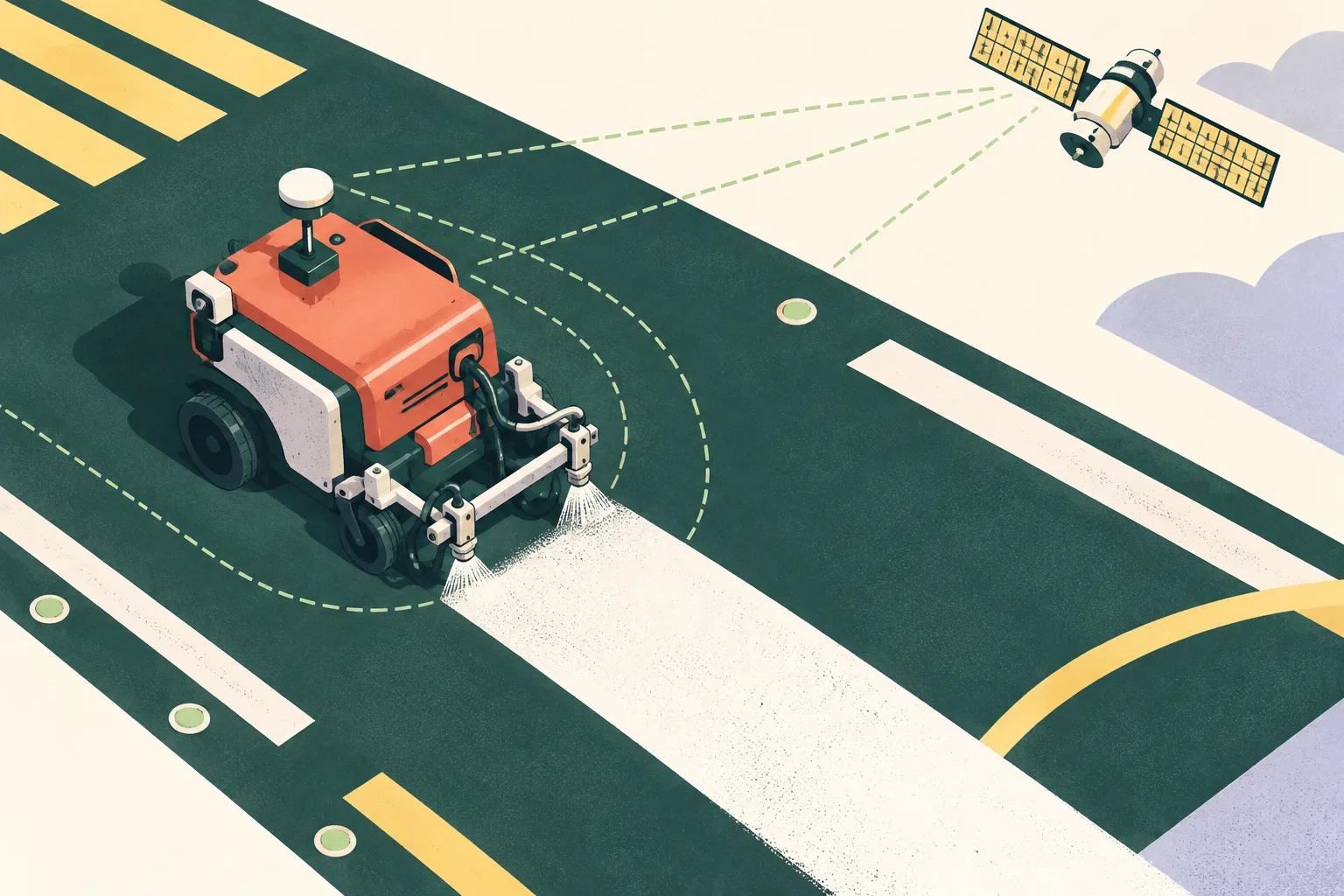
Repainting markings on Hong Kong International Airport’s centre runway normally takes three hours; a paint-spraying robot can do the job in one, according to the airport’s chief operating officer, Steven Yiu Siu-chung. The system began operating at the airport in September 2026. Hong Kong International Airport is the first airport worldwide to use a paint-spraying robot of this kind.
Yiu estimates the robots will reduce the labour hours needed for the work by two-thirds. Runway markings are repainted at intervals ranging from every week to every six months, and the work has to be done during overnight runway-maintenance periods. He said the job is strenuous and has been difficult to staff.
Satellite positioning guides the robot’s sprayer, allowing it to place markings to centimetre-level accuracy. It connects to several navigation systems, including GPS, GLONASS, Galileo and BeiDou. A high-resolution camera and lidar help it detect obstacles; if one is detected, the robot stops automatically.
The technology began as equipment for marking sports fields, then was adapted for airport use through a development project with the Civil Aviation Department. The airport uses a dual-nozzle robot for straight lines and a single-nozzle version for bends.
The Hong Kong Airport Authority uses robots for general runway-marking repainting, while staff continue to handle specific procedures.