


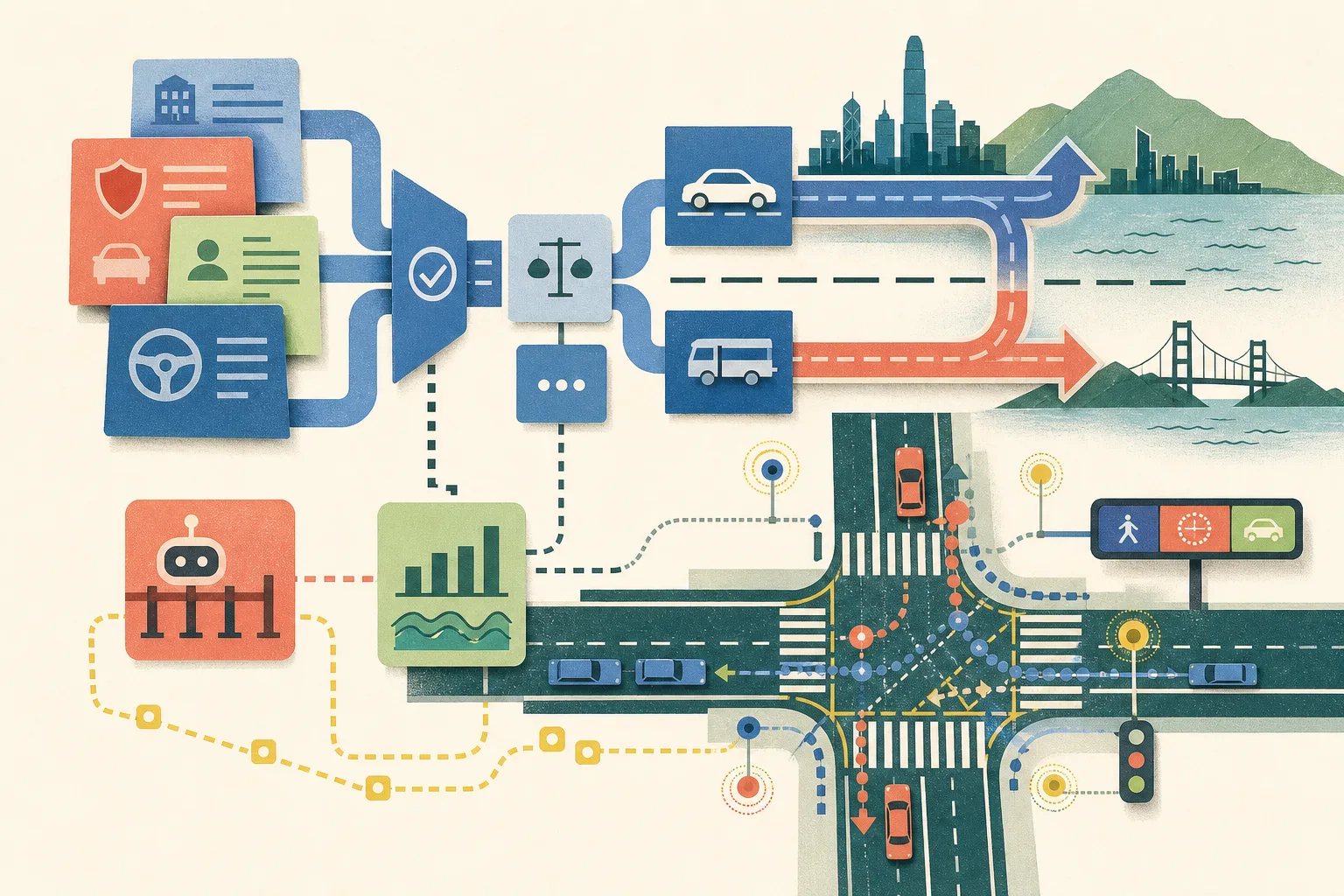
The Transport Department plans to introduce an upgraded artificial intelligence-assisted approval system by the end of 2026 for online vehicle-licence renewals and applications under the “Hong Kong cars going north” and “Guangdong cars coming south” cross-boundary driving schemes. The department says the system could make processing faster for motorists using the online services.
The system will identify, compare and verify information in documents including insurance policies, proof of address, identity documents and driving licences. The department aims for AI to process more than 90% of online vehicle-licence renewal applications automatically and approve more than 50% of applications under the two cross-boundary schemes.
The department says vehicle-licence renewals that can currently take as long as 10 working days could be completed in one working day. Cross-boundary applications require more documents, and reports say the new system could reduce the amount of time spent handling those applications manually by about 20%.
The new system will build on the department’s existing use of AI and optical character recognition to assist with checking licence-application documents. It will add capabilities based on large language models, but the department’s targets do not mean that every application will be approved automatically.
The department has also used AI to identify and block automated bots that take online appointment queue slots for counters issuing Hong Kong full driving licences without a test. The system began operating in late June 2026 after problems emerged when online reservations were fully implemented in March. Reports said waiting times for people who successfully entered the appointment system fell from about two hours to under or around 45 minutes.
Separately, the department plans to pilot an AI-controlled traffic-signal system in the first quarter of 2027 at the junction of Gloucester Road and Great George Street, near Victoria Park in Causeway Bay. Sensors and real-time analysis of pedestrian and vehicle flows will be used to adjust signal timings and give pedestrians more green-light time. The department expects the system to reduce pedestrians’ maximum waiting time by 15 to 20 seconds.
The department says the traffic sensors will collect pedestrian and vehicle-flow data but not facial images, licence-plate data or other personally identifiable information. It says it will consult or comply with the Office of the Privacy Commissioner for Personal Data and applicable privacy rules. The exact launch arrangements for the online system and the traffic-signal pilot, how applications not approved automatically will be handled, and whether the Causeway Bay project will be expanded have not been specified.