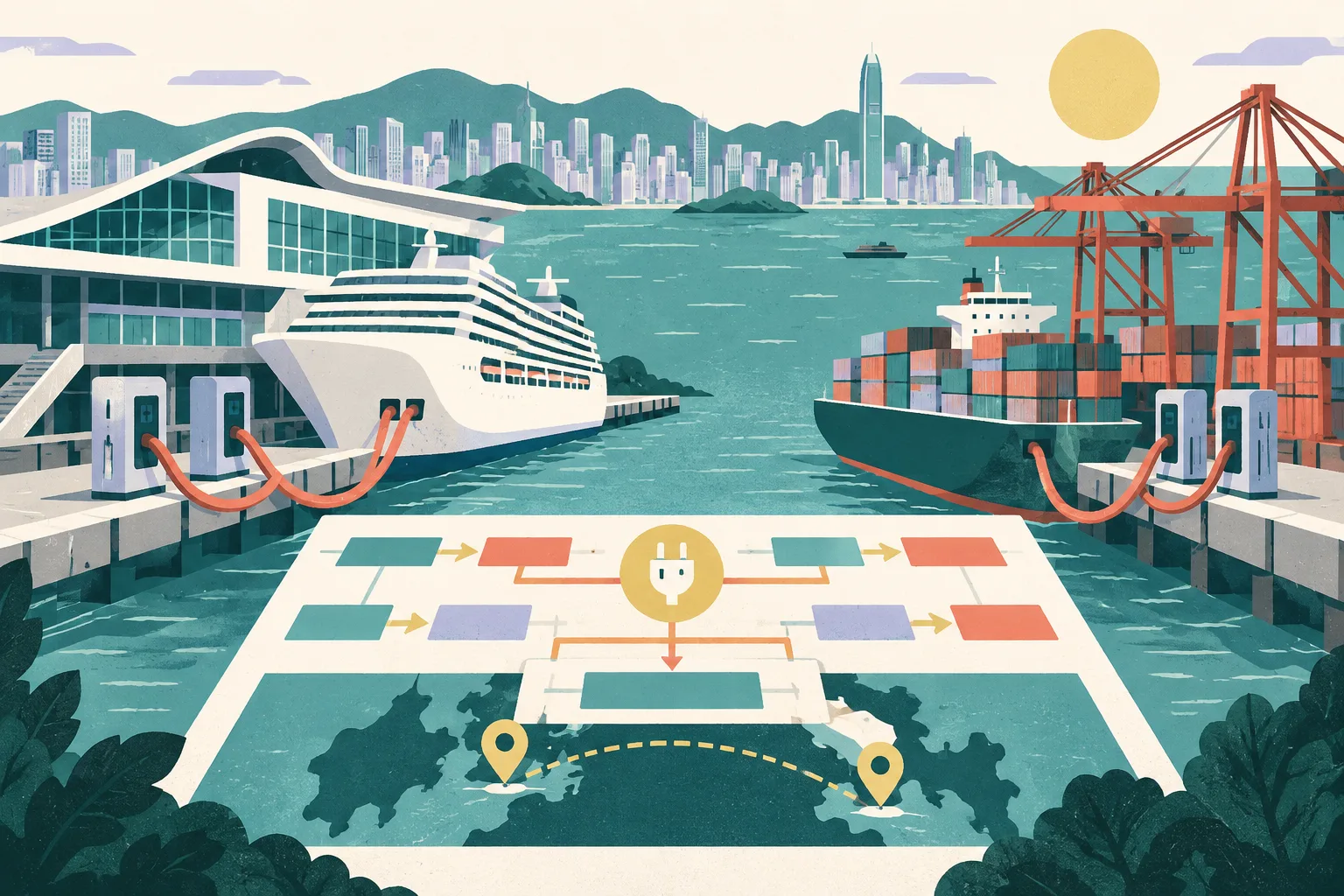
A seven-member group of G19 lawmakers has urged the Hong Kong government to set a clear timetable and roadmap for cutting emissions from maritime transport, with shore-power facilities at Kai Tak Cruise Terminal identified as the first priority. The Green Shipping Promotion Group made the call in a joint proposal released on 11 September 2026.
The group proposed a cross-department co-ordination mechanism to oversee the transition, along with stronger top-level planning and common standards. It also called for greater financial resources and emissions-reduction incentives, and for the development of zero-carbon ports, green marine-fuel bunkering and a related trading centre.
The proposal seeks early action at Kai Tak Cruise Terminal. Ming Pao reported that two shore-power stations have been installed there but have not yet been energised. Shore power allows a vessel to use an onshore electricity supply while berthed, but the proposal did not set out when the facilities would become operational.
The lawmakers also urged the government to draw up a construction timetable for shore-power facilities at Kwai Tsing Container Terminals and other sites. One lawmaker suggested initially retrofitting about half of the Kwai Tsing berths, or roughly 10 berths, with the government covering 20 per cent of conversion costs. This was presented as an example, rather than an agreed policy.
Other recommendations include considering statutory status for the Hong Kong Maritime and Port Board, allowing it to lead overall maritime and port planning and strategy. The group also proposed subsidies and tax concessions for vessel retrofits or purchases of new-energy ships, and the creation of a Hong Kong shipping and maritime technology research institute to train talent and explore a “Hong Kong research, Greater Bay Area manufacturing” model.
A lawmaker said fuel prices had risen to nearly twice their level since the start of the conflict in the Middle East, creating difficulties for transport operators. The lawmaker said electric or methanol-powered vessels could potentially lower operating costs if suitable charging infrastructure were available.
Lam Ming-fung said lawmakers would raise the proposals again during the Budget process if the Chief Executive’s Policy Address, expected the following week, did not cover green shipping. Government decisions on the proposed co-ordination mechanism, funding and tax measures, as well as the schedules, costs and responsibilities for shore-power projects, had not been settled.