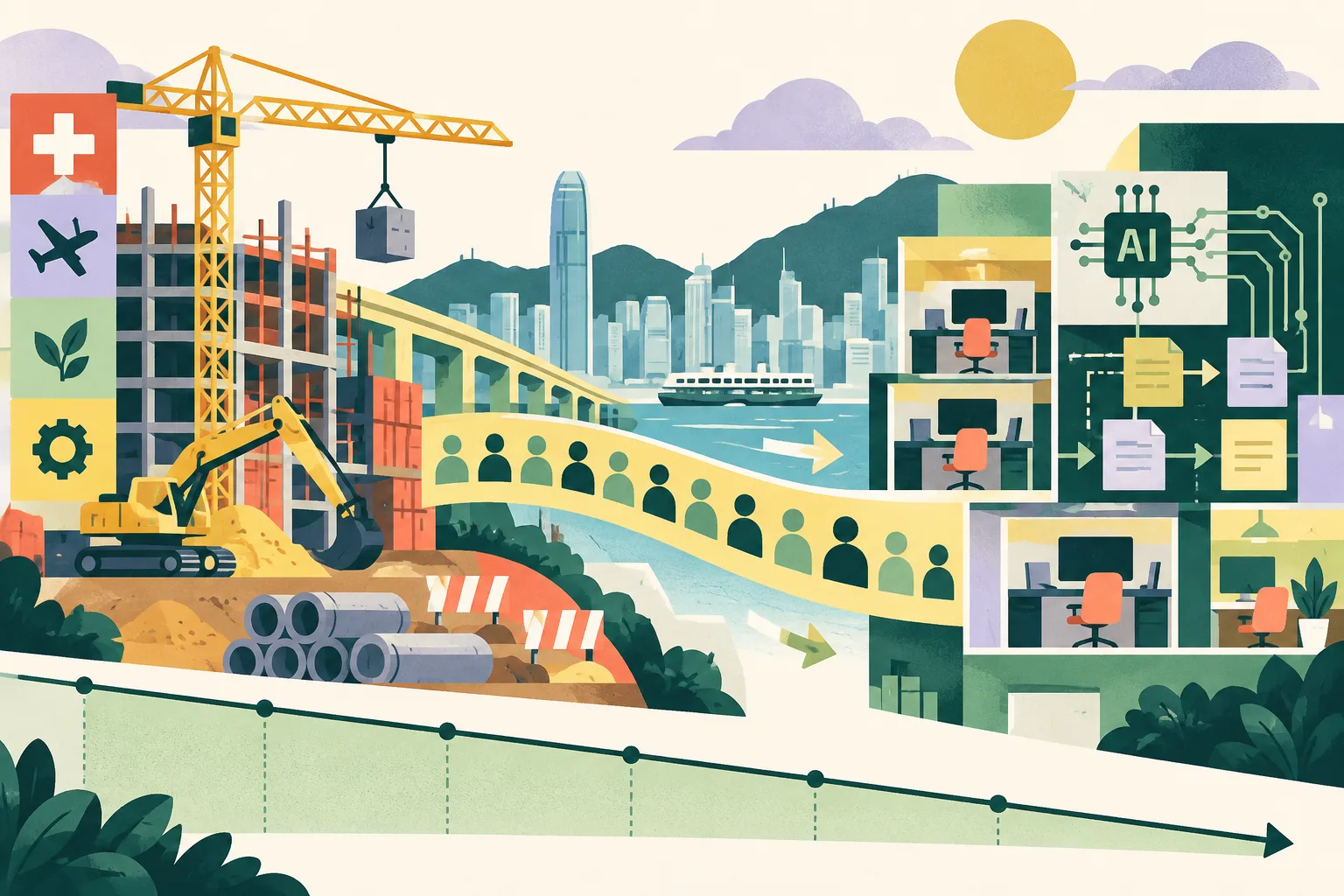
Hong Kong’s overall manpower shortage is forecast to narrow to about 130,000 by 2028, from roughly 180,000 in the previous projection. The estimate from the Labour and Welfare Bureau includes the contribution of imported talent and labour measures, but the improvement will be uneven across the economy.
Construction is expected to have the largest gap among the selected industries, at 30,000 to 40,000 workers, followed by city operations at about 20,000 to 25,000. Healthcare, aviation, and innovation and technology are also forecast to remain under pressure.
By occupation, skilled technical workers and service and sales workers are expected to account for about 60% of the projected shortage. The bureau linked the pressure to an ageing workforce and difficulty attracting younger entrants, while noting that these jobs continue to depend heavily on interpersonal interaction and complex craft skills.
The wider labour-force figures show why imported workers and talent are central to the projection. Excluding foreign domestic helpers, Hong Kong’s labour force fell from 3.5 million in 2023 to 3.47 million in 2025. It is expected to decline to 3.4 million by 2028 even after additional labour supply. Without the imported-labour measures, the bureau estimates that it would fall to about 3.21 million and the overall manpower shortage would reach 300,000.
Artificial intelligence is creating a different pattern of pressure. Clerical support workers are projected to show a surplus of about 25,000 to 30,000 in 2028 as businesses use AI for routine administrative work. The bureau estimates that AI could raise productivity in affected jobs by 20% to 30%, while 20% to 30% of mainly clerical positions may be restructured.
The report says suitable vacancies for new graduates have fallen by about 60% compared with 2022 as AI affects entry-level work. About 70,000 middle-aged clerical support workers without tertiary qualifications are also under pressure to transition. Businesses are expected initially to manage the transition mainly through natural attrition, keeping the short-term risk of large-scale layoffs low, while demand for AI specialists rises.
Head of the Labour and Welfare Bureau Chris Sun said talent attraction and labour import policies had helped stabilise the workforce and ease the shortage, and that the government would develop measures for AI-driven job redesign. Acting Secretary for Labour and Welfare Ho Kai-ming said employers were likely to become more cautious about entry-level recruitment and that the government would formulate adjustments in response to the update.